
Frankenstein
Frankenstein
by Mary Shelley
Victor Frankenstein builds a living being and then abandons it. The creature’s education, and Victor’s refusal to answer for what he made, are the book’s real experiment.
Subject
Early speculative fiction about time, invention, and other worlds. The ideas travel; the editions on this shelf are the old ones, not modern retellings.
by Mary Shelley
Victor Frankenstein builds a living being and then abandons it. The creature’s education, and Victor’s refusal to answer for what he made, are the book’s real experiment.

by H. G. Wells
A Victorian inventor rides his machine to a future in which humanity has split. Wells’s novella is a social argument dressed as a traveler’s report.

by H. G. Wells
Martian cylinders fall on the English countryside and the narrator walks through the collapse of ordinary life. Wells aimed the invasion at the empire that had invaded others.
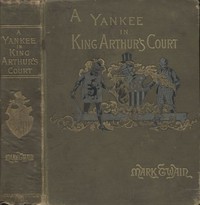
by Mark Twain
A Connecticut Yankee in King Arthur's Court was originally titled A Yankee in King Arthur's Court. Some early editions are titled A Yankee at the Court of King Arthur.

At the Back of the North Wind was serialized in the children's magazine Good Words for the Young beginning and was published in book form. At the Back of the North Wind is a fantasy centered on a boy named Diamond and his adventures with the North Wind.

by Jack London
Before Adam recounts a man who dreams he lives the life of an early hominid. Before Adam offers an early view of human evolution.

Phantastes: A Faerie Romance for Men and Women turns on the character Anodos ("pathless" in Greek) and takes its inspiration from German Romanticism, particularly Novalis. Phantastes: A Faerie Romance for Men and Women concerns a young man who is pulled into a dreamlike world and there hunts for his ideal of female beauty, embodied by the "Marble Lady".

by L. Frank (Lyman Frank) Baum
Published on June 7, 1919, one month after the author's death, The Magic of Oz relates the unsuccessful attempt of the Munchkin boy Kiki Aru and former Nome King Ruggedo to conquer Oz.

by L. Frank (Lyman Frank) Baum
Dorothy and the Wizard in Oz was published on June 18, 1908 and reunites Dorothy Gale with the humbug Wizard from The Wonderful Wizard of Oz. This is one of only two of the original fourteen Oz books to be illustrated with watercolor paintings.

by L. Frank (Lyman Frank) Baum
The Road to Oz was originally published and documents the adventures of Dorothy Gale's fourth visit to the Land of Oz. The Road to Oz was followed by The Emerald City of Oz.

Sylvie and Bruno, first published, and its second volume Sylvie and Bruno Concluded published, form the last novel by Lewis Carroll published during his lifetime. Both volumes were illustrated by Harry Furniss.

Looking Backward, 2000 to 1887 was translated into several languages, and in short order "sold a million copies. " According to historian Daniel Immerwahr, "In the 19th-century United States, only Uncle Tom's Cabin sold more copies in its first years" than Bellamy's book.

The Light Princess was published in as a story within the larger story Adela Cathcart. Drawing on inspiration from the story "Sleeping Beauty", it recounts a princess afflicted by a constant weightlessness, unable to get her feet on the ground, both literally and metaphorically, until she finds a love that brings her down to earth.

The Princess and Curdie is the sequel to The Princess and the Goblin. The adventure continues with Princess Irene and Curdie a year or two older.

Five Children and It was originally published the Strand Magazine under the general title The Psammead, or the Gifts, with a segment appearing each month. The stories were then expanded into a novel which was published the same year.

by Jack London
The Red One was first published in the October issue of The Cosmopolitan, two years after London's death. The Red One was reprinted in the same year by MacMillan, in a gathering of London's stories of the same name.

The Phoenix and the Carpet is the second in a trilogy of novels that begins with Five Children and It, and follows the adventures of the same five children: Cyril, Anthea, Robert, Jane and the Lamb. Their mother buys the children a new carpet to replace one from the nursery that they destroyed in an accidental fire.

The Story of the Amulet is the final part of a trilogy of novels and is preceded byFive Children and It and The Phoenix and the Carpet.

by L. Frank (Lyman Frank) Baum
Tik-Tok of Oz has little to do with Tik-Tok and is primarily the quest of the Shaggy Man (introduced in The Road to Oz) to rescue his brother, and his resulting conflict with the Nome King. Tik-Tok of Oz was based on Baum's play The Tik-Tok Man of Oz, which was produced in Los Angeles in spring.

by Mark Twain
Extract from Captain Stormfield's Visit to Heaven first appeared in print in Harper's Magazine in December and January, and was published in book form with some revisions. This was the last story published by Twain during his life.

by Jack London
The Iron Heel is a dystopian and political novel in the form of science fiction by American writer Jack London, first published.

by Bram Stoker
The Lair of the White Worm was first published by Rider and Son of London, the year before Stoker's death, with colour illustrations by Pamela Colman Smith. The Lair of the White Worm is based on the legend of the Lambton Worm.

A Journey in Other Worlds: A Romance of the Future is a science fiction novel by John Jacob Astor IV, published.

Lilith: A Romance is considered among the darkest of MacDonald's works, and among the most profound. In the story, MacDonald mentions a cosmic sleep that heals tortured souls, preceding the salvation of all.

The History of Caliph Vathek was composed in French beginning, and then translated into English by Reverend Samuel Henley in which form it was first published in without Beckford's name as An Arabian Tale, From an Unpublished Manuscript, claiming to be translated directly from Arabic.

New Atlantis appeared unheralded and tucked into the back of a longer work of natural history, Sylva Sylvarum ("Forest of Materials"). In New Atlantis, Bacon portrays a vision of the future of human discovery and knowledge, expressing his aspirations and ideals for humankind.

The Wood Beyond the World was first published in hardcover by Morris's Kelmscott Press,. The Ballantine edition includes an introduction by Lin Carter.
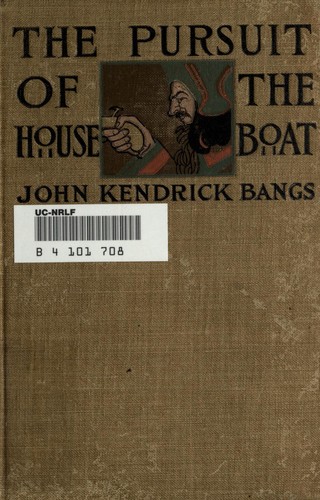
The original full title was The Pursuit of the House-Boat: Being Some Further Account of the Divers Doings of the Associated Shades, Under the Leadership of Sherlock Holmes, Esq. And it has also been titled In Pursuit of the House-Boat and Pursuit of the House-Boat.

The Enchanted Castle is a children's fantasy novel by Edith Nesbit first published.

by H. Rider (Henry Rider) Haggard
She and Allan brought together his two most popular characters, Ayesha from his novel She (to which it serves as a prequel), and Allan Quatermain from his novel King Solomon's Mines. Umslopogaas from Nada the Lily also appears in the novel as a major character.

A Strange Manuscript Found in a Copper Cylinder was serialized posthumously and anonymously in Harper's Weekly, and published in book form by Harper and Brothers of New York City in 1888. A Strange Manuscript Found in a Copper Cylinder was serialized subsequently in the United Kingdom and Australia, and published in book form in the United Kingdom and Canada.

by Daniel Defoe
The Consolidator; or, Memoirs of Sundry Transactions from the World in the Moon is a fictional adventure by Daniel Defoe published. The Consolidator; or, Memoirs of Sundry Transactions from the World in the Moon is a satirical novel that mixes fantasy, political satire, and social satire.

The Story of Ab, or The Story of Ab: A Tale of the Time of the Cave Man, is a novel written by Stanley Waterloo.

The House on the Borderland is a hallucinatory account of a recluse's stay at a remote house, and his experiences of supernatural creatures and otherworldly dimensions. Lovecraft praised The House on the Borderland and other works by Hodgson at length.

by Percy Greg
Across the Zodiac The Story of a Wrecked Record is the first science fiction novel set primarily on Mars. Across the Zodiac The Story of a Wrecked Record contains the first documented use of the term "astronaut", here the name of a spacecraft.

by Jules Verne
Facing the Flag is part of the Voyages extraordinaires series. Like The Begum's Millions, which Verne published, it has the theme of France and the entire world threatened by a super-weapon with the threat finally overcome through the force of French patriotism.

by Jules Verne
Around the Moon (French: Autour de la Lune, ), also translated as Circling the Moon and All Around the Moon, is the sequel to Jules Verne's novel, From the Earth to the Moon. All Around the Moon is a science fiction tale which continues the trip to the Moon that was only begun in the first novel.

by Mary Wollstonecraft Shelley
The Last Man concerns Europe in the late 21st century, ravaged by the rise of a bubonic plague pandemic that rapidly sweeps across the entire globe, ultimately resulting in the near-extinction of humanity. The Last Man also includes discussion of the British state as a republic, for which Shelley sat in meetings of the House of Commons to gain insight to the governmental system of the Romantic era.

by Jules Verne
A Journey to the Centre of the Earth was first published in French, then reissued a revised and expanded edition. Professor Otto Lidenbrock is the tale's central figure, an eccentric German scientist who decodes a message from a 16th century Icelandic alchemist who claims to have reached to the very center of the earth via volcanic tubes in the crater of the celebrated inactive Icelandic volcano Snæfellsjökull.

by John Wilkins
The discovery of a world in the moone received generally good reviews as a showcase for the band's experimental/psychedelic pop. The album is the band's first major change in production style compared to earlier albums.

The Mummy's Foot relates the fantastical tale of a contemporary man and the adventures which befall him when he ventures into a Parisian curiosity shop and buys the four-thousand-year-old foot of Princess Hermonthis.

To Whom This May Come 1898 was first published in the February issue of Harper's New Monthly Magazine.

The Angel of the Revolution: A Tale of the Coming Terror was his first published novel and remains his most famous work. The Angel of the Revolution: A Tale of the Coming Terror was first published in Pearson's Weekly and was prompted by the success of "The Great War of " in Black and White magazine, which was itself inspired by The Battle of Dorking.

by F. Marion (Francis Marion) Crawford
Khaled, A Tale of Arabia was first published in hardcover by Macmillan and Co. The Ballantine edition includes an introduction by Lin Carter.
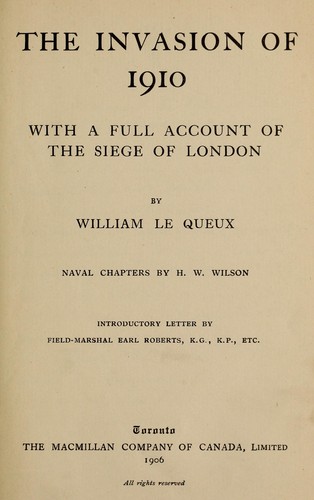
The Invasion is one of the most famous examples of invasion literature. The Invasion is viewed by some as an example of pre-World War I Germanophobia.

In a Glass Darkly, v. 2/3: the second and third stories are revised versions of previously published stories. The first three stories are short stories, and the fourth and fifth are long enough to be called novellas (the fourth is over 44,500 words long, and the fifth is over 27,500 words long).

The World Masters is one of the longest-running and most prestigious of the BDO/WDF tournaments. The World Masters was originally contested as the best of 5 legs (first to 3) before later transitioning to the set format.

by Mary Wollstonecraft Shelley
Frankenstein; Or, The Modern Prometheus recounts Victor Frankenstein, a young scientist who creates a sapient creature from different body parts in an unorthodox scientific experiment. Shelley started writing the story when she was 18 and staying in Bath, and the first edition was published anonymously in London on 1 January, when she was 20.

Anno Domini 2000; or, Woman's Destiny was written by former Prime Minister of New Zealand Sir Julius Vogel while he was in England.

The Mummy! A Tale of the Twenty-Second Century concerns the Egyptian mummy of Cheops, who is brought back to life in the year 2126. The Mummy! A Tale of the Twenty-Second Century describes a future filled with advanced technology, and was the first English-language story to feature a reanimated mummy.

The Battle of Dorking: Reminiscences of a Volunteer is a novella by George Chesney, starting the genre of invasion literature and an important precursor of science fiction. Written just after the German victory in the Franco-Prussian War, it describes an invasion of Britain by a German-speaking country referred to in oblique terms as The Other Power or The Enemy.

A Message from Mars is a play by Richard Ganthony, first performed at London's Avenue Theatre in November.