
A Christmas Carol
A Christmas Carol
Ebenezer Scrooge is walked through his past, the present he refuses to see, and a future he can still change. Dickens wrote it quickly, and it became the Christmas story people mean.
Author
Dickens filled novels with institutions, comic speech, and people the city would rather not count. The books here run from a short Christmas tale to the long arc of Great Expectations.
Ebenezer Scrooge is walked through his past, the present he refuses to see, and a future he can still change. Dickens wrote it quickly, and it became the Christmas story people mean.

London and Paris before and during the French Revolution, joined by a look-alike, a prisoner, and a sacrifice. The opening sentence is famous; the plot earns it.

Pip is lifted out of a forge by money whose source he misunderstands. Dickens’s late novel is about class, gratitude, and the patron Pip invents in his head.

The Mystery of Edwin Drood was his final novel and was left unfinished when he died. Though the novel is named after the character Edwin Drood, it focuses more on Drood's uncle, John Jasper, a precentor, choirmaster and opium addict, who lusts after his pupil, Rosa Bud.

The Posthumous Papers of the Pickwick Club (also known as The Pickwick Papers) was the first novel by English author Charles Dickens, first published in serial form. Because of his success with Sketches by Boz published, Dickens was asked by the publisher Chapman & Hall to supply descriptions to explain a series of comic "cockney sporting plates" by illustrator Robert Seymour, and to connect them into a novel.

Master Humphrey's Clock began with a frame story in which Master Humphrey tells about himself and his small circle of friends (which includes Mr. Pickwick), and their penchant for telling stories. Several short stories were included, followed by the novels The Old Curiosity Shop and Barnaby Rudge.

The Haunted Man and the Ghost's Bargain: A Fancy for Christmas-Time is a novella by Charles Dickens first published. The Haunted Man and the Ghost's Bargain is the last of Dickens's five Christmas novellas, following A Christmas Carol, The Chimes, The Cricket on the Hearth and The Battle of Life.

Pictures from Italy reveals the concerns of its author as he presents, according to Kate Flint, the country "like a chaotic magic-lantern show, fascinated both by the spectacle it offers, and by himself as spectator".

American Notes for General Circulation is a travelogue by Charles Dickens detailing his trip to North America. While there he acted as a critical observer of North American society, almost as if returning a status report on their progress.

The Battle of Life: A Love Story is a novella by Charles Dickens. The Battle of Life is the fourth of his five "Christmas Books", coming after The Cricket on the Hearth and followed by The Haunted Man and the Ghost's Bargain.

A Child's History of England first appeared in serial form in Household Words, running from 25 January to 10 December. Dickens also published the work in book form in three volumes: the first volume on 20 December, the second on 25 December and the third on 24 December.

The Old Curiosity Shop was so popular that New York readers reputedly stormed the wharf when the ship bearing the final instalment arrived. The Old Curiosity Shop was printed in book form two volumes.

Oliver Twist; or, The Parish Boy's Progress, is the second novel by English author Charles Dickens. The story stays with orphan Oliver Twist, who, after being raised in a workhouse, escapes to London, where he meets a gang of juvenile pickpockets led by the elderly criminal Fagin, discovers the secrets of his parentage, and reconnects with his remaining family.

Hard Times: For These Times (commonly known as Hard Times) is the tenth novel by English author Charles Dickens, first published. Hard Times surveys English society and satirises its social and economic conditions.

Dombey and Son stays with the fortunes of a shipping firm owner, who is frustrated at the lack of a son to follow him in his footsteps; he initially rejects his daughter's love before eventually becoming reconciled with her. Dombey and Son features many Dickensian themes, such as arranged marriages, child cruelty, betrayal, deceit, and relations between people from different British social classes.

Our Mutual Friend is the fourteenth and final novel completed by English author Charles Dickens and is one of his most sophisticated works, combining savage satire with social analysis.

"To Be Read at Dusk" is a short story written by Charles Dickens, first published in The Keepsake.

Little Dorrit features Amy Dorrit, youngest child of her family, born and raised in the Marshalsea prison for debtors in London. Arthur Clennam encounters her after returning home from a 20-year absence, ready to begin his life anew.

Martin Chuzzlewit was originally serialised between January and July. While he was writing it, Dickens told a friend that he thought it was his best work thus far, but it was one of his least popular novels, judged by sales of the monthly instalments.

Bleak House has many characters and several subplots, and is told partly by the novel's heroine, Esther Summerson, and partly by an omniscient narrator. At the centre of Bleak House is a long-running legal case in the Court of Chancery, Jarndyce and Jarndyce, which comes about because a testator has written several conflicting wills.

"A Message from the Sea" is a set of short stories by Charles Dickens, Wilkie Collins, Robert Buchanan, Charles Allston Collins, Amelia Edwards and Harriet Parr, written in 1860 for the Christmas issue of All the Year Round.

Tom Tiddler's ground, also known as Tom Tidler's ground or Tommy Tiddler's ground, is a longstanding children's game. One player, "Tom Tiddler", stands on a heap of stones, gravel, etc.

Originally published, Doctor Marigold was extremely successful, as were Dickens's public performances of a play based on the story--fascinating and easy to read. Doctor (it is his given name) Marigold is a "Cheap Jack" or what we would call a street peddler.

A House to Let was originally published the Christmas edition of Dickens's Household Words magazine. Collins wrote the introduction and collaborated with Dickens on the second story and ending, while Gaskell and Proctor wrote the third and fifth chapters respectively.
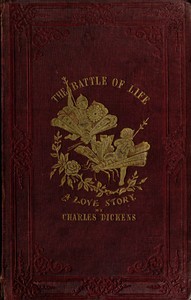
The Battle of Life: A Love Story is the fourth of his five "Christmas Books", coming after The Cricket on the Hearth and followed by The Haunted Man and the Ghost's Bargain.